
You grab a few logs from the pile you left out last night and nothing catches. The lighter works fine. The paper curls and burns out. The wood just sits there, smoking uselessly while the morning gets colder. This is the wet firewood problem – not a downpour, not some survival emergency, just damp wood that won’t cooperate.
Starting a campfire with wet wood is mostly a moisture and wood structure problem, not a mystery. Once you understand what’s actually happening inside that log, the fix becomes obvious.
This article contains affiliate links. If you purchase through these links, I may earn a small commission at no extra cost to you. My recommendations are based on personal experience and thorough testing. Read my full disclosure for details.
Split the log and use the dry interior. Wet firewood is usually only damp on the outside – the core is still dry. Peel the bark, split it, shave kindling from the inner faces, and build your fire from the inside out. Use fatwood or a commercial fire starter as your base if you don’t have dry tinder. That’s 90% of it. Everything below is the details.
Why Wet Firewood Won’t Light
Water doesn’t just sit on the surface of wood. Even surface moisture pulls heat away from your flame faster than the wood fiber can reach ignition temperature. Your lighter is spending all its energy evaporating moisture instead of starting combustion. That’s why wet wood smokes for a long time before it catches – or never catches at all.
If the fire takes longer than expected and the temperature is dropping, it helps to know how to stay warm in a tent at night while you wait it out.
Most campsite wood is only damp on the outside. Morning dew, an overnight mist, a day or two stored without cover — that’s surface moisture. The interior of the log is still dry. A truly waterlogged log that’s been sitting in standing water for weeks is a different problem, and honestly, not worth fighting.
Quick field test: snap a small branch. If the inside is pale and snaps clean, it’s dry inside. If it bends, feels fibrous, or looks dark — it’s genuinely wet through.
Preparation Is Key
Most campfire failures with damp wood happen because people reach for the lighter first. Preparation comes first. Always.
Before you build anything, assess what you’re working with. Pick up a few pieces of firewood and feel the surface. Cold and slightly tacky means surface damp — workable. Soft, heavy, and dark on the end grain means it’s been wet for a while — harder, but still possible with the right approach.
Sort your wood into three piles: logs for splitting, pieces already thin enough to use as kindling, and anything that needs to dry near the fire before it’s usable. Two minutes of sorting saves twenty minutes of frustration.
If you’re camping somewhere with pines, scan nearby stumps before assuming all the wood is wet. Fatwood — resin-saturated heartwood from old pine stumps — stays burnable even after rain.
How to Find Dry Wood at a Campsite in Wet Conditions
Ground-level wood is almost always the dampest. Don’t start there.
Look up first. Dead branches still attached to trees — standing dead wood — stay significantly drier than anything on the ground because they’re not wicking moisture from the soil. A branch that snaps cleanly off a dead limb is often dry enough to use as kindling without any prep at all.
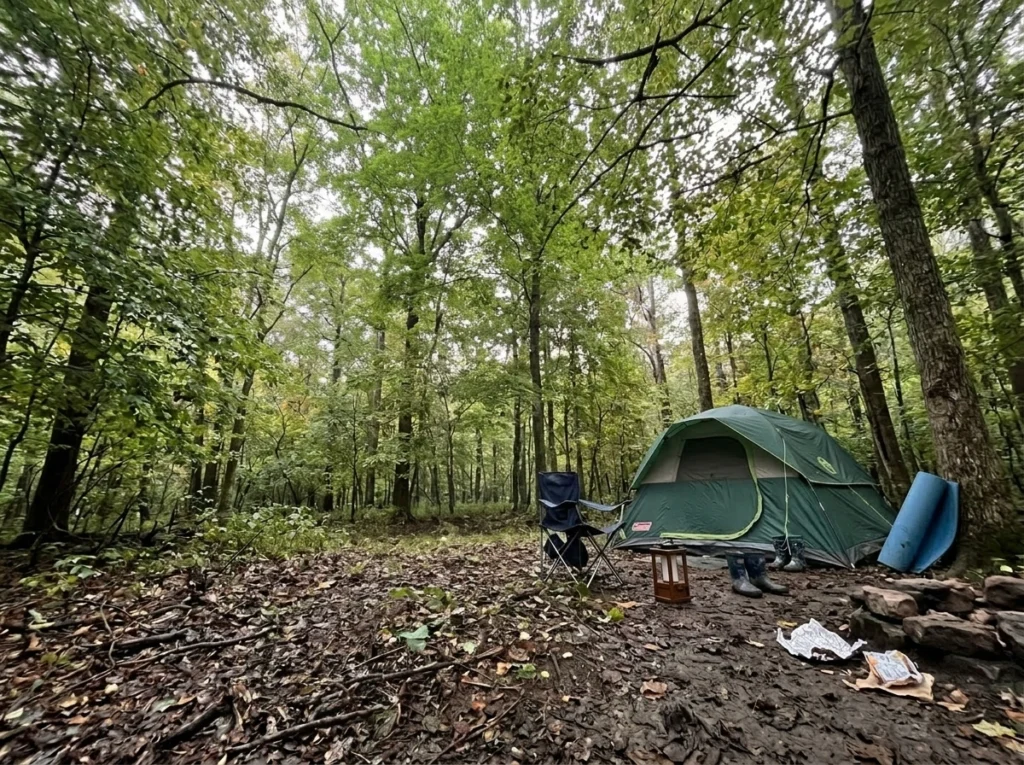
Look under dense canopy. Thick tree cover acts like a roof. The ground and lower branches beneath it can stay dry through light rain and overnight dew.
Look at the undersides of fallen logs too. The top surface gets rained on; flip a log and the bottom half is often noticeably drier. even a damp log has a dry interior. You don’t need to find perfect wood. You need to find wood you can split.
How to Build a Campfire With Wet Wood — Step by Step
If you already know how to build a campfire in normal conditions, wet wood is just some extra steps.
Split the Log and Expose the Dry Interior
First, peel the wet bark. Use a camp knife and strip it off before you do anything else. Bark is the dampest part of the log — it holds moisture like a sponge and will fight your fire the entire time it’s on there. Takes 30 seconds per piece. Do it.
Then split the log. A hatchet or sturdy fixed-blade knife is all you need. One split gives you two flat, exposed inner faces that are far drier than the exterior. Split again — four faces. Now you have real material.
From those pale inner faces, shave kindling. Thin strips, roughly ⅛ inch wide and 4–5 inches long. The thinner, the faster they catch. Use only the light-colored interior wood — that outer inch near the bark holds moisture even after splitting.
The Feather Stick Technique for Wet Wood
A feather stick is a branch you carve so the shavings stay attached at the base, curling upward like a tiny wooden broom. Cut down into the stick at a shallow angle, stopping just before you cut through, so each shaving stays connected.
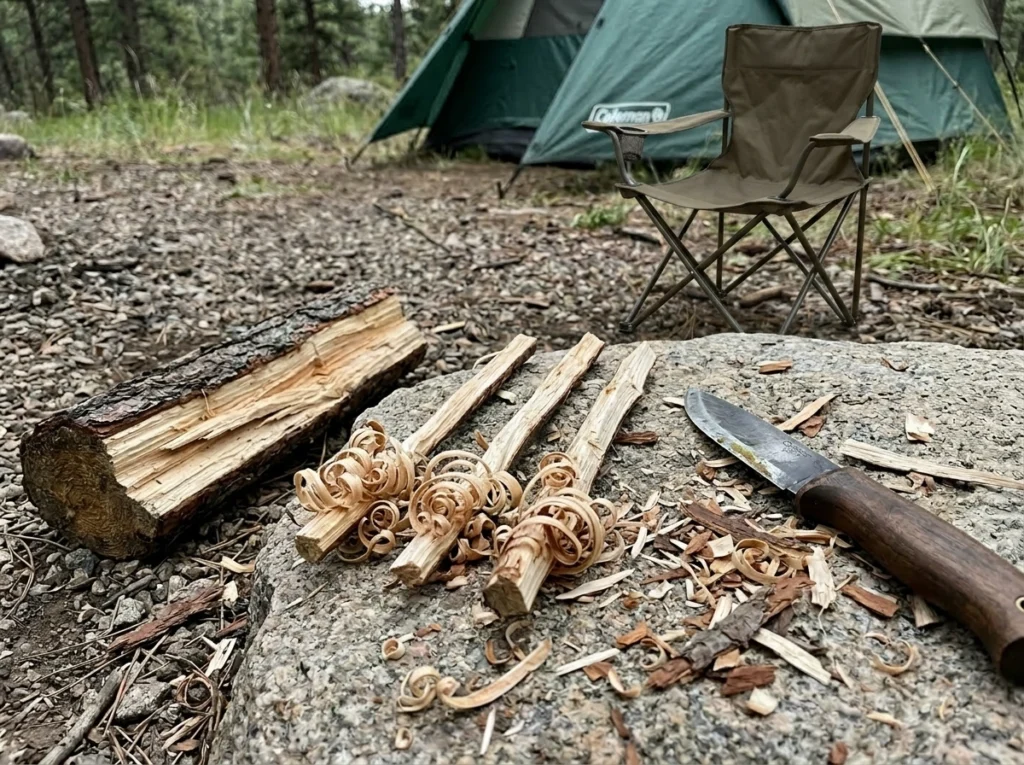
The result is a piece of wood with dramatically more surface area than a plain stick. Two or three feather sticks at the base of your fire make a real difference in how fast it builds.
The wood has to come from a split log’s dry interior. Same rule, every time.
Build a Dry Platform First
Don’t build your fire directly on wet ground. Wet soil wicks heat away from the base of your fire just like it does from the wood itself.
Lay two or three flat pieces of split wood side by side as a base platform before you put any tinder down. This insulates your fire from ground moisture and gives the heat somewhere to build upward instead of being absorbed downward. It takes an extra two minutes and makes a noticeable difference in how fast the fire catches — especially in the morning when ground temperature is coldest.
Best Tinder for Wet Wood Conditions
Ranked from most to least reliable in damp conditions:
- Fatwood shavings — resinous, catches even when slightly damp, burns hot
- WetFire tinder cubes — purpose-built for wet conditions, hard to mess up
- Magnesium shavings — scraped from a fire starter block, burn extremely hot even when wet
- Petroleum jelly cotton balls — cheap, homemade, 3–4 minutes of burn time
- Dry inner shavings from split logs — free and effective, requires prep work
- Birch bark from underside of logs — burns well, find it on flipped logs
One note on tinder quantity: in wet conditions, you need roughly four times more tinder and kindling than you would on a dry day. That sounds like a lot, but it makes sense — the fire needs sustained heat long enough to evaporate moisture from larger logs before they’ll catch. Gather more than feels necessary before you light anything.
The Best Way to Start a Campfire With Wet Wood Using Fire Starters
Fatwood is resin-saturated heartwood from the core and roots of old dead pine stumps. The resin concentration is so high it burns even when the outside is damp. Cut into it and it smells strongly of pine, almost like turpentine. That smell is exactly what you want.
Split a chunk into thin sticks and it’ll catch with just a lighter, no extra tinder needed. At a campsite near pines, check old stumps — the root area is often packed with fatwood even after a rainy night.
You can also consider Fatwood firestarter sticks, which cost about $15–$25 per bag. A single bag should last most of a camping season.
Waterproof Fire Starters Worth Having in Your Kit
UCO Stormproof Matches (~$12) burn for about 15 seconds in wind and rain — long enough to get fatwood or a tinder cube going regardless of conditions.
WetFire Tinder Cubes (~$13 per pack) are small waxy blocks that burn hot and long. Drop one in a puddle and it still lights. One cube under your kindling buys the sustained heat that damp wood needs to catch.
Magnesium fire starter block — scrape shavings into your tinder pile and strike the flint. The magnesium burns at over 5,000°F and doesn’t care how wet the surrounding wood is. Available at Bass Pro Shops, Cabela’s, and most outdoor sections at Walmart.
Petroleum jelly cotton balls — make a batch before you leave home and pack them in a zip-lock. They cost almost nothing and burn 3–4 minutes per ball.
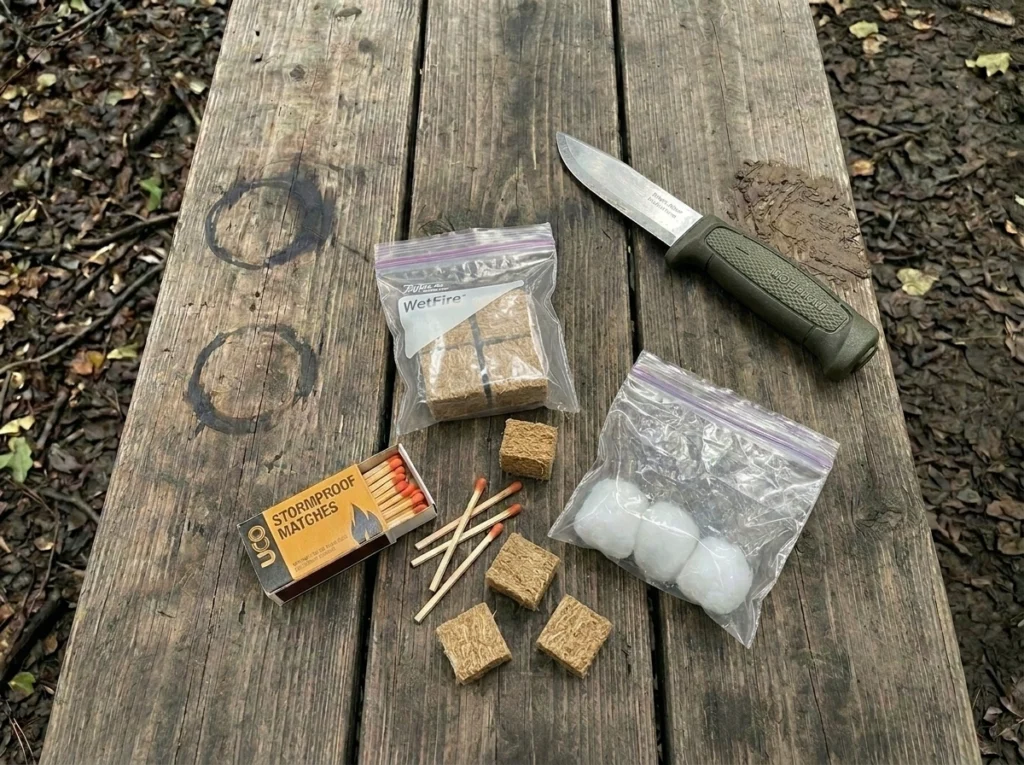
I keep some of these in a small dry bag in my kit. The one trip I left them all at home, it had rained overnight. Forty minutes on what should have been a five-minute job.
My Honest Take
The first time I dealt with genuinely damp firewood, I just kept relighting the same logs with more paper. Went through half a notepad. Total waste.
What fixed it was borrowing a hatchet from a neighbor at the campsite and splitting everything down. The interior of those logs was completely dry — almost blond-colored — and caught on the third try. I’d been fighting the outside of the wood for 20 minutes when the inside was fine the whole time.
Stripping the bark and splitting — that’s the real skill here. Everything else, feather sticks, fatwood, magnesium blocks, tinder cubes, is just insurance. Good insurance, worth having. But if you can peel and split, you can almost always get a fire going.
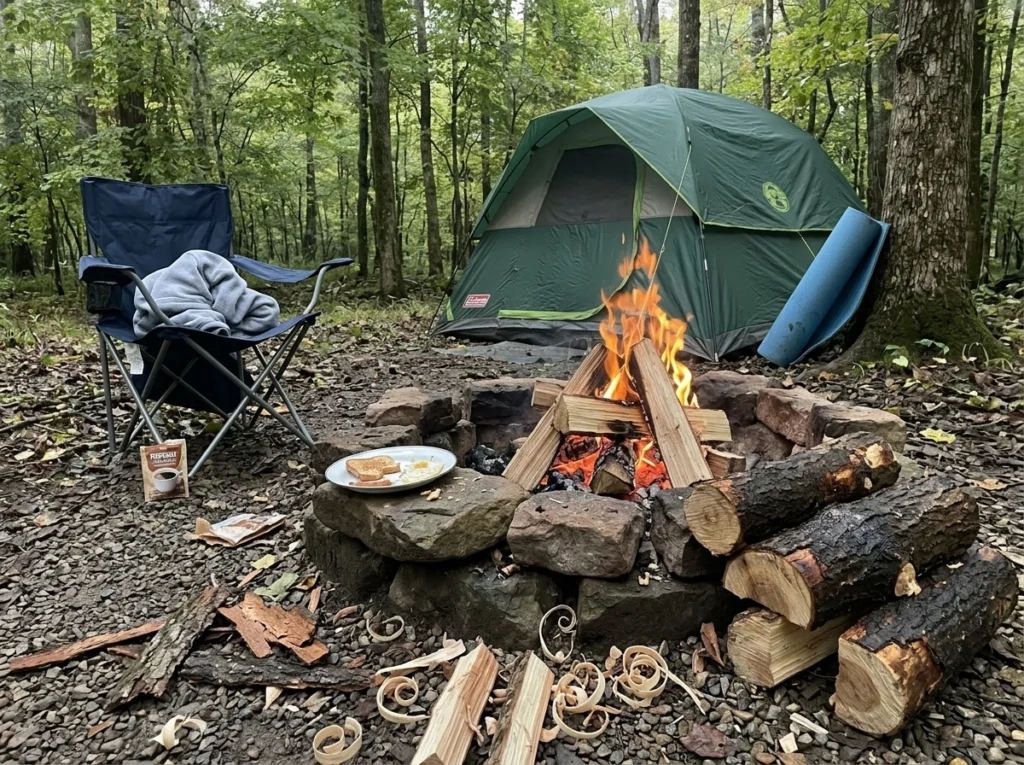
Also: that heavy white smoke before the fire catches is not failure. It’s moisture burning off. Most people give up right before it would’ve worked.
FAQs — Starting a Campfire With Wet Wood
Before You Go: What to Actually Pack
If you camp in the fall or spring — or anywhere in the Pacific Northwest — wet wood is going to happen. Pack a small fatwood bundle, a few petroleum jelly cotton balls in a zip-lock, and a hatchet you trust. Those three things together solve almost every damp campfire problem without drama.
If you want to go back to basics first, our step-by-step campfire guide for beginners walks through the whole process from scratch.
And if it’s actively raining while you’re trying this — not just damp wood but rain falling on your fire — that’s a different problem. We cover that in our article on starting a campfire in the rain.
Pingback: How to Start a Fire Without Matches (6 Proven Methods) - The Out Camp