

Most people buy the wrong mattress for truck bed camping for the same reason: they measure the bed, not the space between the wheel wells. These are two different numbers, and that difference is why a mattress that should fit ends up bowing in the middle or hanging off the sides.
I’ve made that mistake. I’ve also woken up at 3 AM on what was basically a deflated pool toy sitting on corrugated metal. So this is the rundown I wish I’d had – what fits, what actually keeps you warm, and how to figure out which one makes sense for your truck before you spend anything.
This article contains affiliate links. If you purchase through these links, I may earn a small commission at no extra cost to you. My recommendations are based on personal experience and thorough testing. Read my full disclosure for details.
For most truck campers, a tri-fold memory foam pad, 4–6″ thick, is recommended. It’s warm, puncture-proof, and sets up in 30 seconds. If you want an air mattress for your truck bed, buy one made specifically for pickup trucks – standard camping air mattresses don’t fit between the wheel wells. Measure the width between your wheel wells before you buy anything. That number is what matters.
Before You Buy: 4 Things to Check First
Most mattress-buying mistakes happen before you opens a product page. Do these first.
1. Measure between the wheel wells – not the overall bed width That’s your usable flat sleeping width. Write it down.
2. Measure bed length with the tailgate closed If you’re over 6 feet tall, check whether you need to sleep with the tailgate down – that changes your mattress choice.
3. Know your bed liner situation Raised corrugated liner? A thin air mattress will sit on those ridges and leak faster. Flat liner or bare metal? Either works, but add insulation underneath.
4. Decide: mild-weather camping or cold-weather camping? Foam insulates. Air mattresses don’t. If you camp in fall, at elevation, or anywhere temps drop below 50°F at night, that decision matters more than brand or price.
Why a Regular Mattress Won’t Work in a Truck Bed
This sounds obvious until you’re at 11 PM trying to wrestle a queen air mattress into a space that physically won’t accept it – the same problem comes up when people try to fit an air mattress in a tent without measuring first.
The problem is the wheel wells. They jut up from the floor on both sides, and the usable flat width between them is narrower than the overall bed. A standard double or full air mattress is about 53″ wide. The space between most full-size truck wheel wells is closer to 50–52″, and on a mid-size truck it drops to 44–48″. So a regular camping air mattress either doesn’t fit, or hangs up over the wells and turns into a hammock in the middle. Neither is great.
The other thing: truck beds have ridges in the floor. Most corrugated liners or bare metal beds have raised channels running lengthwise. Lay a thin air mattress on those ridges and you’re asking for a slow leak before sunrise. I found this out the first trip. Woke up at 3 AM basically sleeping on metal.
Three Types of Truck Bed Camping Mattresses
Tri-Fold Foam – The Most Reliable Mattress for a Truck Bed
This is the one I keep coming back to. A 4–6″ tri-fold memory foam mattress folds into thirds, fits behind the seats or in a cargo area, and sets up in about 30 seconds – just unfold it. No pump needed. No valve to find in the dark.
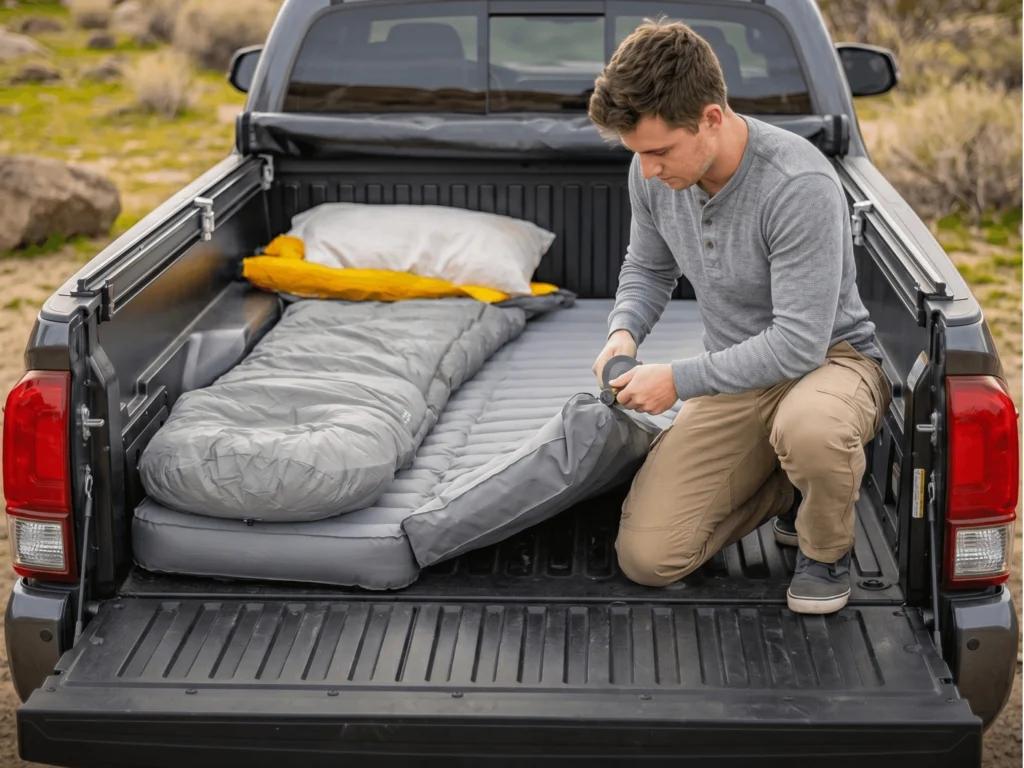
The reason foam wins for trucks specifically: it doesn’t care about the ridges. Set it down and it conforms. It also insulates. Metal truck beds get cold. Air mattresses trap cold air inside them; foam does not. If you camp in the fall, spring, or in any area with elevation involved, this matters more than you’d think.
The trade-off is bulk. Folded into thirds, it’s still a thick slab you need to find a home for — behind the seat, stuffed in the cab, or eating into the bed space you’re trying to sleep in. If you’re packing for a week and every inch counts, that matters.
Air Mattress for Truck Bed: Truck-Specific vs. Standard
Regular camping air mattresses don’t fit truck beds cleanly. I’ve already covered why. But there is a category of inflatable mattresses made specifically for truck beds – shaped to account for the wheel wells, with notched cutouts or a narrower profile that actually sits flat in the bed.
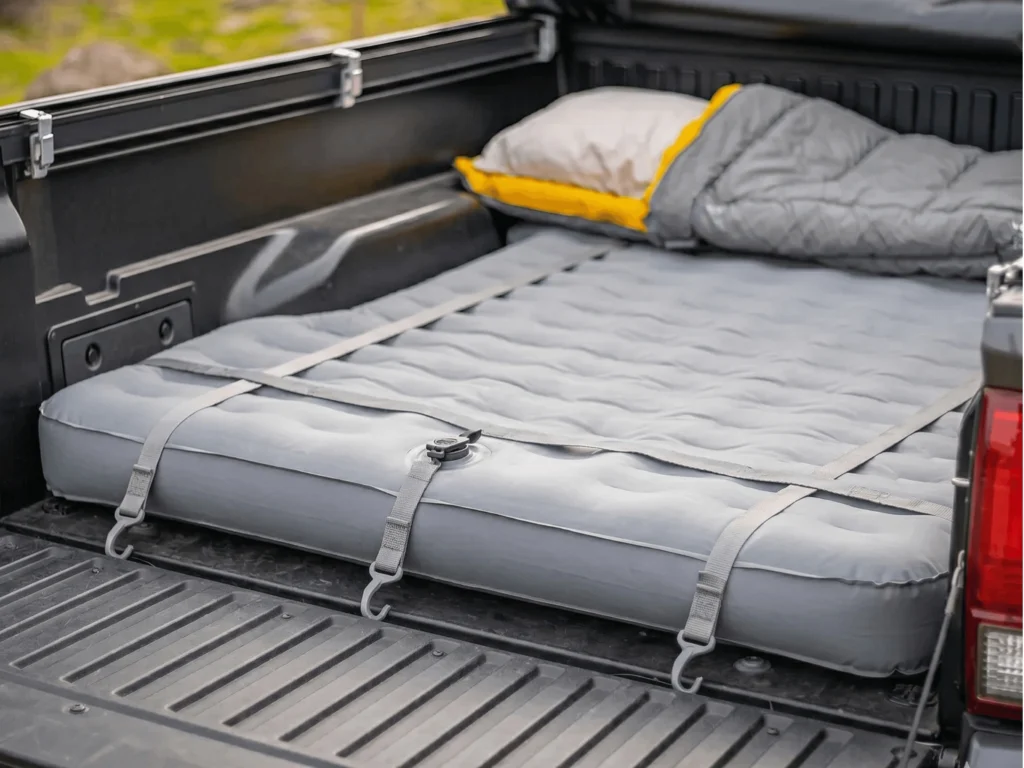
They cost more than a standard blow-up mattress — the Rightline Gear Truck Bed Air Mattress runs around $80–$90 and is one of the more consistently reviewed options. Some come with anchor straps that hook over the tailgate so the mattress doesn’t slide when you climb in. Worth having.
The real downside with any air mattress for truck bed camping use: cold. The air inside absorbs and releases temperature fast. Sleep on one at 45°F without insulation underneath and you’ll feel it within an hour. Put a closed-cell foam pad or a folded moving blanket between the mattress and the bed floor before you inflate. That single layer changes the whole experience.
Inflatable Mattress for Truck Bed: Self-Inflating Pads
Somewhere between foam and air. A 2.5–4″ self-inflating pad unrolls, opens a valve, and gets most of the way there on its own — you add a few breaths to firm it up. They’re more packable than foam and warmer than a plain air mattress because there’s actual foam inside.
The problem for truck camping specifically: they’re narrow. Most self-inflating pads are designed for one person in a tent. For two people, you’re buying two pads and hoping they stay side-by-side through the night. They also cost more per square inch of sleeping surface than a basic foam option.
Worth considering for solo truck campers who want something compact. For couples or anyone who moves around in their sleep? Not the first choice.
Truck Bed Mattress Sizing – Get This Wrong and Nothing Else Matters
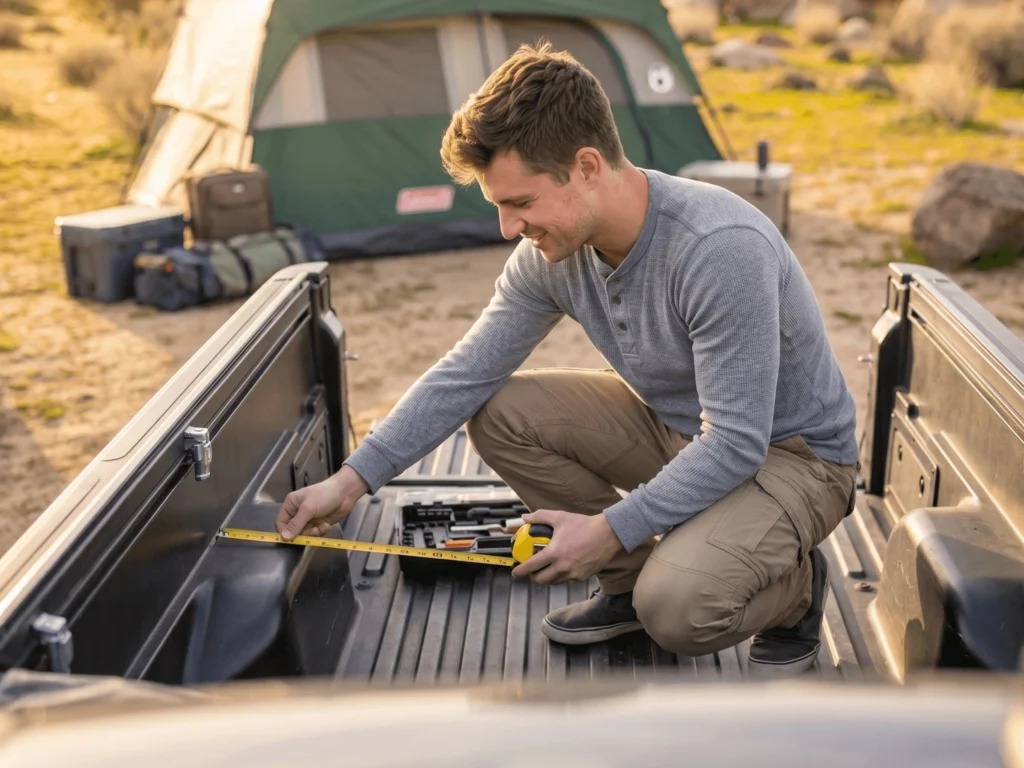
Before you buy anything, measure your truck bed. Don’t use the manufacturer’s listed dimensions. Actual usable width between wheel wells varies by model year and whether you have an aftermarket liner installed. Take a tape measure.
| Truck Type | Approximate Width Between Wheel Wells | Suggested Mattress Width |
|---|---|---|
| Full-size (F-150, RAM 1500, Silverado) | 50–53″ | 50–52″ foam or truck-specific air |
| Mid-size (Tacoma, Ranger, Colorado) | 44–47″ | 44–46″ cut foam or truck air |
| Short bed vs. long bed | Same width, different length | Measure length too — 5.5 ft vs 6.5 ft |
Length matters if you’re over 6 feet tall. A lot of truck-specific air mattresses top out around 78–80″ when fully inflated. That’s enough for most people, but check before you buy.
The Cold Floor Problem With Air Mattresses for Truck Beds
Cold ground kills sleep in a tent. Cold metal kills it faster in a truck.
A truck bed floor conducts cold directly into whatever’s sitting on it. Foam handles this on its own. An air mattress for a truck bed does not — the air inside equalizes with the surrounding temperature. At 38°F outside, that mattress is working against you all night.
The fix most articles skip: put Reflectix insulation under your mattress.
It’s a foil bubble wrap material sold at hardware stores for a few dollars, and you can cut it to the exact shape of your bed floor – wheel wells and all. Lay that down first, mattress on top. The difference between this and sleeping on bare metal is significant. I didn’t figure this out until my third truck camping trip. First two trips I just blamed the mattress.
Whether you need it depends on where and when you camp. Summer desert? Skip it. Fall in the Ozarks or anywhere with elevation? Don’t sleep without it.
My Honest Take
I’ve gone back and forth on this more than I should have. Started with a regular camping air mattress that I already owned – it was too wide for the wheel wells, so it bowed up in the middle. Bought a truck-specific inflatable mattress next. It fit better, but I kept waking up cold even with a decent sleeping bag.
The foam mattress I eventually tried felt like overkill when I bought it. Bulky. Heavy. Took up half the bed while driving. But the first night I used it I slept six straight hours without waking up once, which hadn’t happened in the truck before. So now that’s what I use.
One thing I’ll add that the spec sheets don’t tell you: if you’re extending your sleep length by dropping the tailgate, cold air comes up through the gap between the tailgate and the mattress edge. Doesn’t sound like a big deal until you’re dealing with it at 2 AM. A stuff sack or rolled fleece shoved into that gap fixes it. Small thing, but nobody mentions it.
I’m not going to tell you the foam is always the right call. If you’re packing for a week and space is tight, a good truck-specific air mattress with Reflectix underneath is a workable setup.
FAQs
One Last Thing Before You Order Your Truck Bed Mattress
The measurements and the mattress type – you’ve got that now. The one step most people still skip is the insulation layer underneath. Reflectix from any hardware store, cut to fit your bed floor. Costs about $10 [VERIFY PRICE]. Do that regardless of which mattress you pick and you’ll sleep warmer than someone who spent three times as much on a better mattress and skipped it.
If temperatures are your bigger concern – not just in the truck but camping in general — the piece on how to stay warm sleeping outdoors at night is worth reading next. Most of it applies directly to truck sleeping too.
That’s the setup. Go measure your wheel wells.