
You’re at the campsite, the sun’s dropping, and the lighter that’s lived in your glovebox for three years has picked tonight to run dry. Or the matches got left on the kitchen counter, right next to the cooler you definitely remembered. Either way, you need a fire, and you need to know how to start a fire without matches using what’s actually in the car right now — not a stick you spent four hours whittling into a masterpiece.
I’m Joseph, and none of this is a survival drill. You drove here. You’ve probably got your car camping setup mostly dialed in already, a phone with signal, and a trunk full of stuff you can improvise with. That changes which of these six methods are worth your ten minutes tonight, and which ones are really just fun to watch in a video.
This article contains affiliate links. If you purchase through these links, I may earn a small commission at no extra cost to you. My recommendations are based on personal experience and thorough testing. Read my full disclosure for details.
Quick Answer
The fastest way to start a fire without matches is a ferro rod struck onto fine, dry tinder — cotton ball, dryer lint, or shredded bark. It works wet, works cold, and takes under a minute once your tinder’s ready. Backups: a 9-volt battery touched to steel wool, a magnifying lens on a sunny day, or flint and steel with char cloth. None of it works well if your tinder’s damp or coarse. That’s most of it — everything below covers the backups and what people get wrong about how to start a fire without matches.
Tinder First: What You Need Before Any Spark
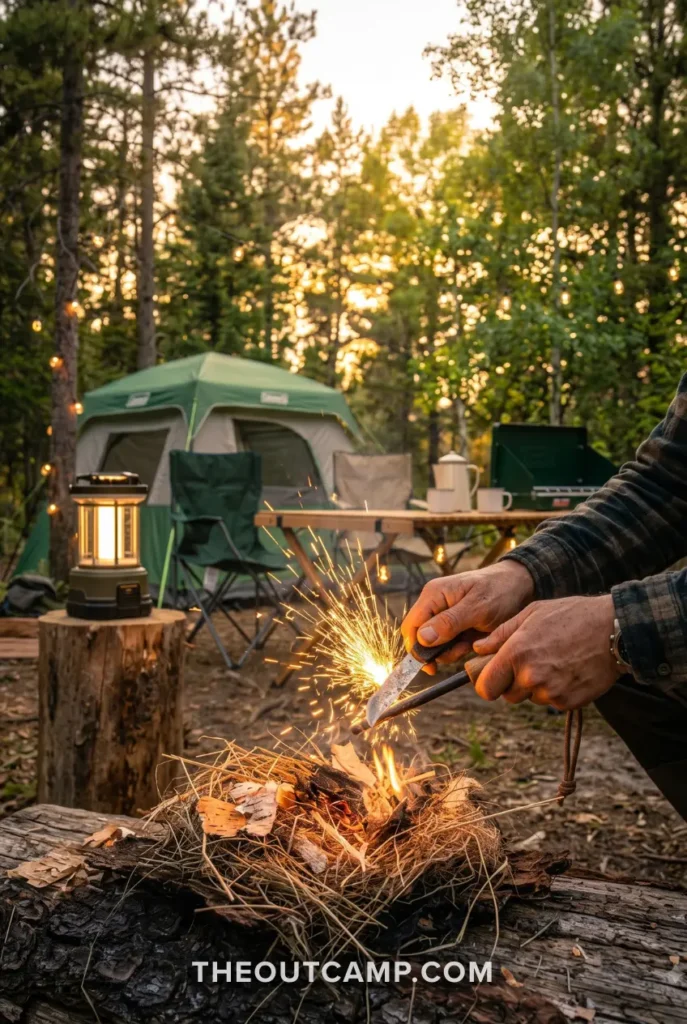
A shower of sparks doesn’t do much on its own. It’s hot for a second or two, then it’s gone, unless it lands on something that’s ready to catch instantly. Beginners spend all their effort mastering the spark and none on the fuel, then can’t figure out why five perfect strikes on a brand-new ferro rod produced exactly nothing. It’s almost never the tool.
The Three Piles You Need
You need three sizes, ready before you make a single spark:
- Tinder — the fine, dry stuff that catches a spark and bursts into flame. Dry grass, shredded inner bark, dead pine needles crushed into fluff, dryer lint, or a cotton ball pulled apart until it’s fuzzy.
- Kindling — pencil-lead to pencil-width sticks. Snap a few first — a clean crack means it’s dry; if it bends instead, it’s still wet.
- Fuel wood — finger-width and up. This goes on once you’ve got real flame, never before.
Have all three in neat piles within arm’s reach. When the spark or ember comes, things move fast, and hunting for kindling in the dark while an ember burns out is exactly how most first attempts fail — not a bad tool, just kindling that’s still ten feet away. Our full breakdown on building a campfire goes deeper on picking and sizing each pile if you want it.
The Cotton Ball and Vaseline Trick
One version worth keeping in the car door pocket: cotton balls worked through with a little petroleum jelly, stored in an old pill bottle. Pull one apart and fluff it before lighting — compressed, it barely catches. They light almost instantly and burn for a few minutes, long enough to dry out slightly damp kindling stacked on top. A jar of Vaseline and a bag of cotton balls runs around $4 to $5 and makes several dozen.
Or Buy Tinder That’s Guaranteed Dry
If the wood itself is damp, not just your tinder, that’s a slightly different problem than this article covers. If finding genuinely dry tinder at all is what you dread, a pack of manufactured tinder cubes like UST’s WetFire solves it for about $8 to $13 depending on pack size. They light even wet and burn several minutes on their own. The trade-off: you’re paying for something a well-fluffed cotton ball does almost as well, for free — call it a nice-to-have, not a must-buy. Either way, it’s one more small edge when you’re figuring out how to start a fire without matches on a trip where the weather didn’t cooperate.
Building the Nest and Moving the Ember
Shape your tinder into a loose nest — fine fibers in the center, slightly coarser material around the outside.
- Get a spark or ember going, using whichever method below fits your situation.
- Drop it into the center of the nest, or tip the nest gently around it.
- Fold the nest loosely closed and lift it up off the ground.
- Blow — long, steady breaths from below, not sharp little puffs. You’re feeding it oxygen, not blowing out a candle.
- When it flares into real flame, set it down and start feeding it the smallest kindling first.
A thick plume of smoke means you’re close, not that it failed. Keep blowing through it.
1. Ferro Rod — The One Worth Actually Buying
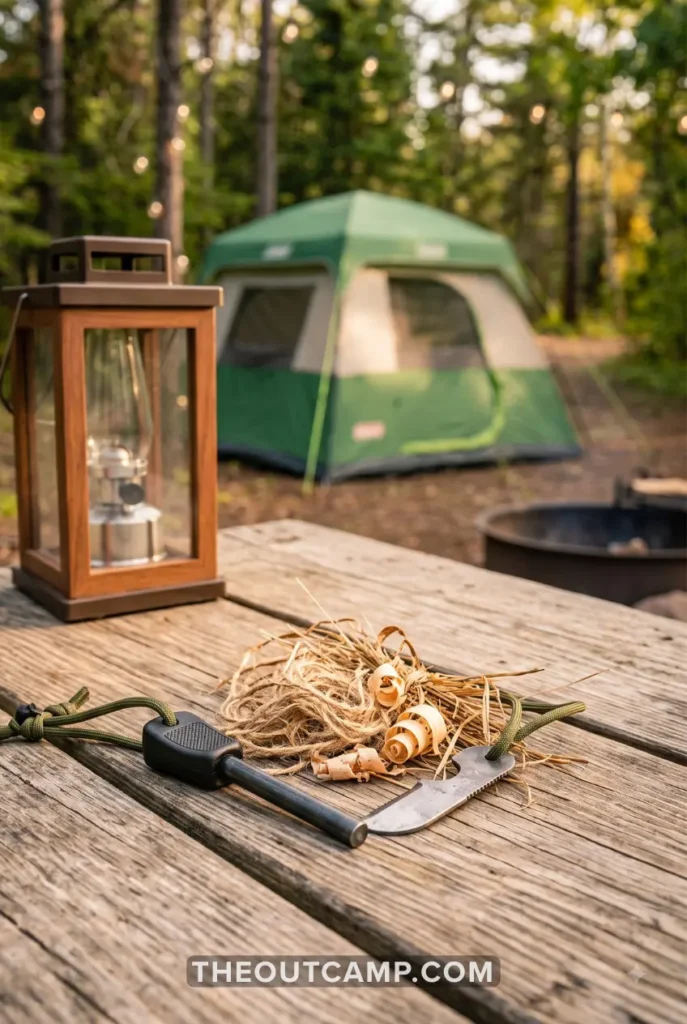
A ferro rod (sold as a “fire steel”) is a rod of magnesium-and-iron alloy that throws sparks up around 5,000°F when you scrape it hard with a metal edge — hot enough to ignite tinder a match would just scorch. It works soaked. It works in the cold. It works after thousands of strikes, long after a lighter’s flint wheel would’ve cracked or its tank run dry.
Most beginners hold it backwards:
- Plant your striker hand still against your knee.
- Set the rod’s tip right at the edge of your tinder.
- Pull the rod back — not the striker forward. That sends sparks straight down onto the fibers instead of off into the dirt.
- Use the spine of a knife or a dedicated striker, never a good blade’s actual edge, unless you enjoy sharpening knives more than necessary.
- Three or four hard scrapes onto fluffed tinder should be enough.
This is the one I’d hand a nervous first-timer — genuinely hard to mess up twice. If you only remember one method for how to start a fire without matches, make it this one.
If you want a specific one instead of guessing at the rack: Light My Fire’s Swedish FireSteel 2.0 is the one most gear reviewers land on, and the one I’d point a first-timer toward. Runs $15 to $20. It’ll outlast the tent you’re pitching it next to. It’s the single item on this list worth keeping in the car permanently — matches or no matches.
2. Battery and Steel Wool — Fastest If You Drove Here
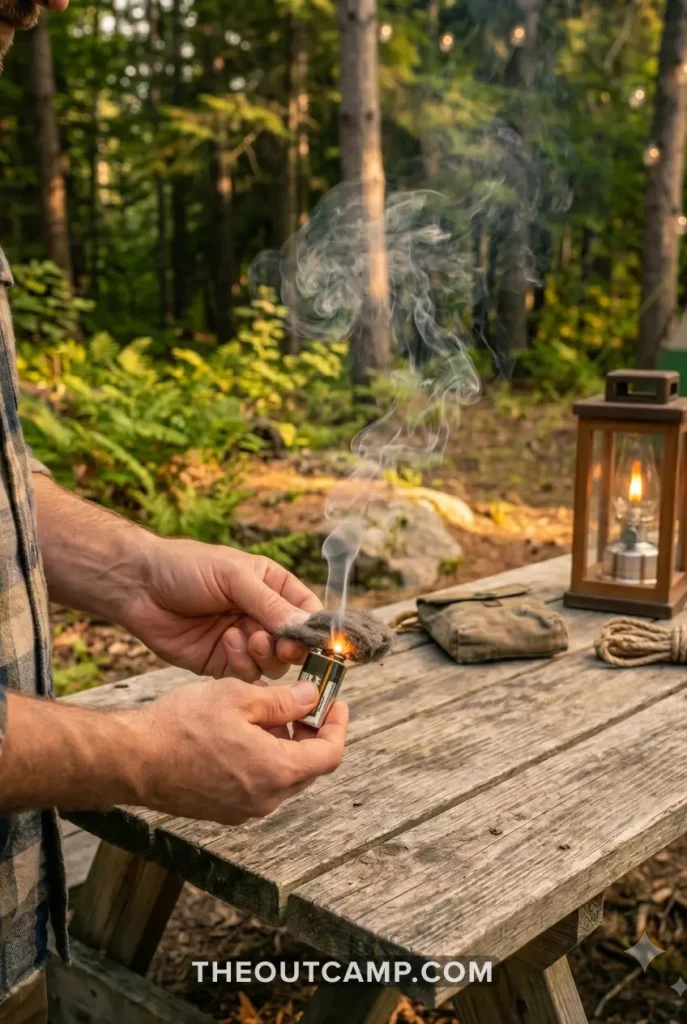
Touch both terminals of a 9-volt battery to a wad of fine steel wool — look for #0000 on the package, the finest grade — and it ignites almost instantly. The wool’s thin enough that the current turns it into a shower of tiny burning threads.
Drop it straight into your tinder nest — one of the fastest ways to start a fire without matches once you’re standing at the car. This is the one I’d hand someone who’s already annoyed and just wants it solved — touch it, it sparks, done.
Here’s the part that’s easy to miss if you’re reading advice written for backpackers: you drove here. Your car has a battery, and a lot of road-trip kits already include a portable jump-starter pack with exposed terminals or a USB port.
Steel wool from a hardware store — a few dollars for a pad that’ll outlast several trips — plus anything with two exposed terminals gets you fire in seconds. Keep it in the console, not the camping bin. It’s dead weight the moment it’s damp, and consoles stay dry.
One trade-off nobody mentions: if your only 9-volt is also the one keeping your smoke detector alive at home, this is a one-shot trick unless you bring a spare.
3. Flint and Steel — Slower, and Kind of Satisfying
This is the older way to start a fire without matches: real flint (or quartz, chert, even some pocketknife spines) struck against high-carbon steel to shave off tiny burning slivers of metal. The sparks run cooler than a ferro rod’s, so they need something more receptive to land on. That’s char cloth.
Making Char Cloth Ahead of Time
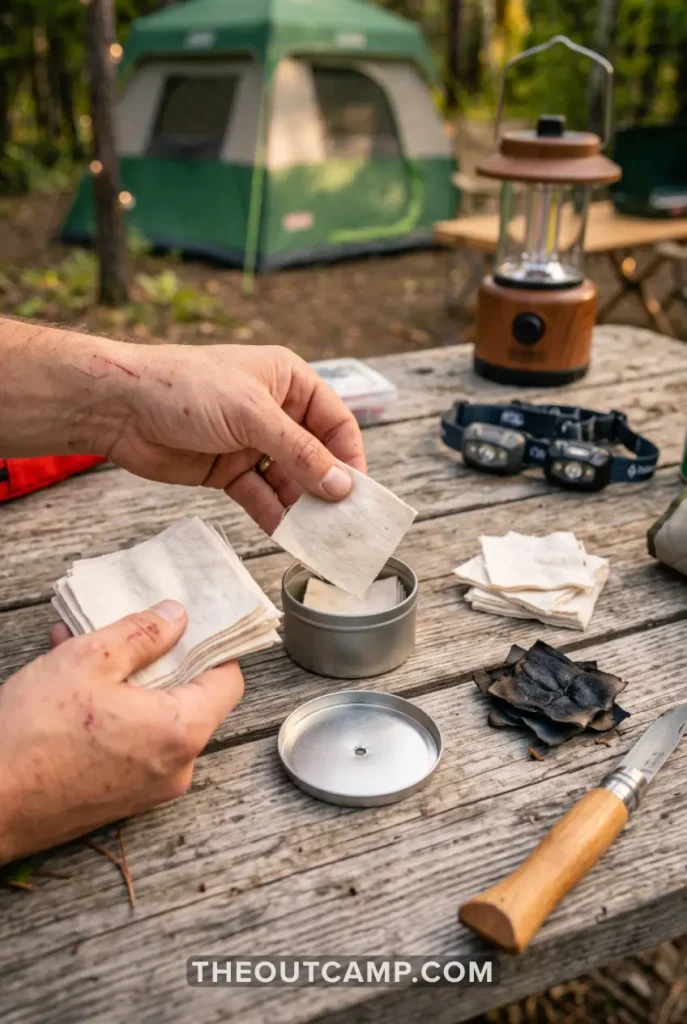
Make it before you leave home — you can’t make it once you’re already stuck without a fire.
- Cut a few 2-inch squares of 100% cotton fabric (an old T-shirt works fine).
- Pack them into a small metal tin with one tiny hole punched in the lid.
- Set the tin in the coals of a fire you’ve already got going.
- Watch for smoke hissing out of the hole, then wait for it to stop — that’s your cue.
- Pull the tin and let it cool fully sealed. Opening it too soon lets air back in and burns the cloth to ash instead of char.
A spark that lands on char cloth catches and holds as a glowing coal, which you fold into your tinder nest same as any other ember. Store leftover squares sealed and bone dry — one damp piece and this whole method is out for the trip. It’s slower than a ferro rod and asks more patience from you, which is honestly why some people like it better. This is the one I’d hand someone who actually enjoys the process, not just the result.
4. Sun and a Lens — Glasses, Bottle, or Magnifier
A magnifying glass, binocular lens, camera lens, reading glasses, or a clear water bottle filled with water can focus sunlight into a single point hot enough to ignite fine, dark tinder. Char cloth or anything already blackened works best here, since dark material absorbs heat faster than pale stuff does.
Hold the lens still and angle it until the bright spot shrinks down to its smallest, sharpest point — an actual pinprick, not a blurry patch. Hold that exact spot over your darkest tinder and don’t move it. It’ll smoke before it flames, sometimes for a minute or longer, which feels like forever when you’re crouched over it waiting.
Skip this one if it’s overcast, late afternoon, or you need fire in the next five minutes. It’s a genuine way to start a fire without matches, just not a fast one, and not something you build a whole evening around.
5. Ash and Cotton — The One Almost Nobody Mentions
If this isn’t your first night at the same fire ring — and on a multi-night car camping trip, it usually isn’t — you may already have the ingredient for this one sitting cold in the pit: ash from your last fire. This is the one I’d show someone who’s convinced they’ve already learned every fire trick there is.
Sprinkle a little cooled ash onto a cotton pad, roll it into a loose tube, and press it flat between two dry, flat pieces of wood. Rub back and forth, slow at first, then faster and harder. The ash works almost like a mild abrasive and heat-holder together, and a small ember can show up in under a minute — genuinely faster than most people expect the first time they try it. It’s not going to replace a ferro rod as your main plan.
But it’s a good one to know, and it works with something most fire-starting guides assume you don’t have on hand: the leftovers of the fire you already had. Still, it’s one more way to start a fire without matches — using leftovers you’d otherwise just kick dirt over.
6. Bow Drill, Hand Drill, and Fire Plow — Worth Knowing, Not Worth Betting On
Every one of these works by grinding friction until wood dust gets hot enough to smolder into an ember: a spindle spun with a bow, a spindle spun between bare palms, or a stick plowed down a groove. They all take real practice and real forearm strength, and usually more than one attempt even for someone who’s done it before. This is the one I’d hand someone with a whole free Saturday and nothing left to prove.
None of them are a reasonable way to start a fire without matches on the night you actually need one fast. They’re a good rainy-Saturday skill to practice in the backyard, with a working lighter in your pocket the whole time, purely for the satisfaction of it. (If you’ve ever watched a survival show turn a bow drill into a roaring fire in what’s clearly one unbroken take, I’d genuinely like to know how many attempts that took off camera.)
If you want the gadget version of the same idea without the forearm workout, a fire piston — a small cylinder that ignites tinder by compressing air fast, same principle as a diesel engine — does the same job for somewhere around fifteen dollars and a lot less sweat.
Check Campfire Restrictions Before You Start
This is one of the most important things to know before you try any of these ways to start a fire without matches: none of the six methods above matter if there’s a burn ban where you’re camping, and depending on the summer, there’s a real chance there is. It’s easy to assume this only applies out west or only in drought years, but plenty of campgrounds run seasonal restrictions as routine policy, not just emergency response. The National Interagency Fire Center tracks fire activity and prevention guidance nationwide.
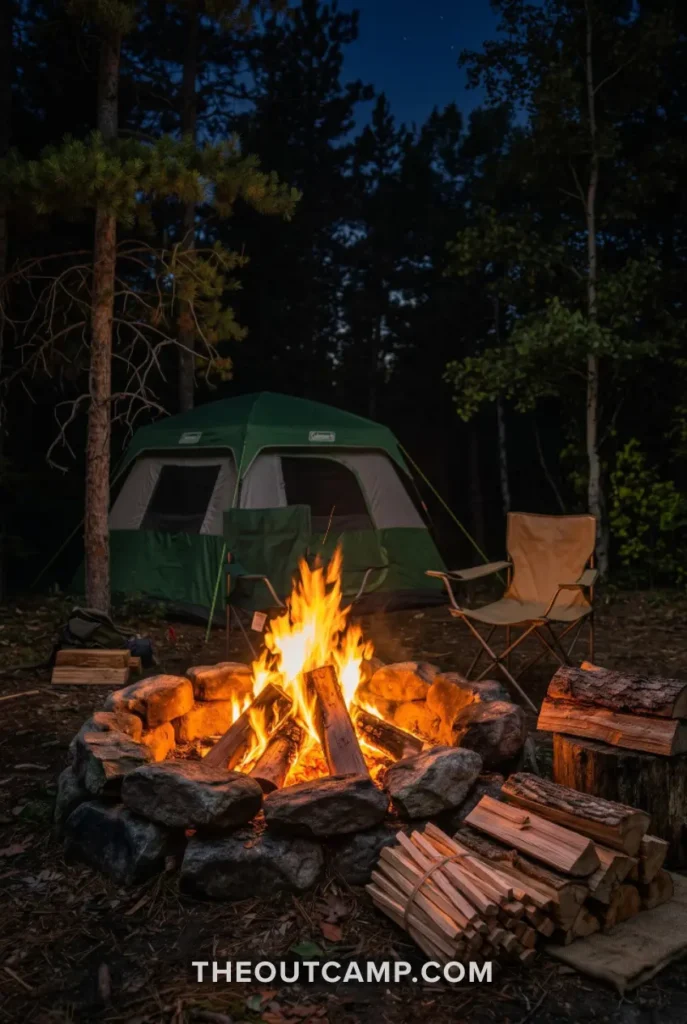
What the Fire-Danger Stages Mean
A lot of campgrounds and state or national parks step through fire-danger stages as conditions get drier. Stage 1 usually still allows a wood fire in an existing, established fire ring. Stage 2 typically bans wood and charcoal fires outright but still allows a gas or propane stove or fire pit, as long as it has an on/off valve. During the driest stretches, some places ban open flame completely — no exceptions, no “just a small one.”
Where to Check Before You Go
Check before you leave, not after you’ve built a beautiful tinder nest for nothing. Most state park systems post current fire restrictions right on their website, national forests and BLM land post theirs too, and a quick call to the campground office or a ranger station clears up anything the website’s vague about. If you land somewhere under a full ban, that’s what a propane camp stove or a battery lantern is for. Not a workaround. Just the actual rule for that weekend.
My Honest Take
Most of what gets written about how to start a fire without matches leans hard on the primitive stuff — bow drills, hand drills, the whole “prove you can do it with nothing but sticks” angle. It photographs well. It doesn’t help much on an actual Tuesday night at a campground when you’re cold, your hands are half-numb, and you just want a fire going before everyone gets cranky and hungry.
Buy the ferro rod. Practice it a few times in the driveway before your first trip, so your hands already know what fumbling feels like before it actually matters. That’s most of the battle right there. I’d rather see someone show up with a five-dollar tool they’ve used twice than someone who’s watched eleven bow-drill videos and never once turned smoke into flame.
Whether it’s worth also carrying a backup — flint and steel, a second lighter, whatever — really depends on how close your campsite is to a gas station that still sells lighters for two dollars. For a lot of car campers, that’s closer than you’d think. Not always, though.
FAQs
Can’t get a spark to catch, even with a ferro rod?
Almost always it’s the tinder, not the tool. Sparks landing on damp material, tightly packed cotton, or anything coarser than fine fluff won’t catch no matter how many times you strike. Fluff your tinder until it looks almost too delicate to use. Also check whether the rod is brand new — most ship with a thin protective coating that has to wear off with a few practice strikes before they spark well.
What’s the best way to start a fire without matches or a lighter?
A ferro rod on tinder you’ve actually prepped, hands down. Once the tinder’s ready, it’s usually under a minute.
How do you start a fire without matches in the rain?
Lean on your prep, not the weather. A ferro rod sparks fine soaking wet, so pair it with a petroleum-jelly cotton ball, which lights even damp. Pull your tinder from dead twigs still attached to a standing tree instead of anything that’s been sitting on the ground. Build low, shelter it with your body or a tarp, and expect it to take longer than it would on a dry day.
Can you really start a fire without matches using a water bottle?
Yes, if the sun’s strong and you’re patient. Fill a clear bottle with water, angle it until the light focuses to a tight point on dark tinder, and hold it still. It’s slow and only works in direct sun, so treat it as a backup, not a plan.
How long does it actually take to start a fire without matches?
With a ferro rod and tinder that’s genuinely ready, well under a minute. With friction methods, a practiced person might take several minutes — a first-timer can take much longer, or fail outright on the first few tries. That gap is exactly why the prep work matters more than which method you pick.
What to Actually Do Before Your Next Trip
Buy one ferro rod and keep it in the car permanently, not the camping bin, so it survives the trip where you forget to repack. Make or buy a handful of petroleum-jelly cotton balls and stash them in an old pill bottle next to it.
Before your next trip, spend ten minutes in the driveway striking sparks onto tinder you fluffed yourself, so the first time you actually need to start a fire without matches isn’t also the first time you’ve tried it. Then check the fire restrictions for wherever you’re headed — a two-minute search that decides whether any of this matters at all that weekend.
Once that first flame catches, turning it into a full campfire that lasts the night is a separate step worth getting right too.